Current location:Home > Organic Chemicals
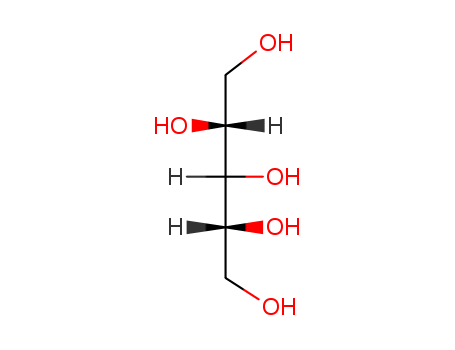
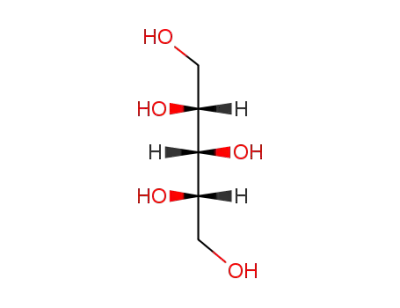
Good factory supply good D-Arabinitol 488-82-4
- Molecular Formula: C5H12O3
- Molecular Weight: 152.147
- Appearance/Colour: white to off-white fine crystalline powder
- Vapor Pressure: 7.47E-12mmHg at 25°C
- Melting Point: 101-104 °C
- Refractive Index: 1.57
- Boiling Point: 494.5 °C at 760 mmHg
- PKA: 13.24±0.20(Predicted)
- Flash Point: 261.9 °C
- PSA: 101.15000
- Density: 1.525 g/cm3
- LogP: -2.94630
D-Arabinitol(Cas 488-82-4) Usage
|
Purification Methods |
This pentol, which occurs in lichens and fungi, is purified by recrystallisation from 90% EtOH or MeOH. [Ashina & Yamagita Chem Ber 67 801 1934, derivarives: Nakagawa et al. Bull Chem Soc Jpn 40 2150 1967, Prince & Reichstein Helv Chim Acta 20 101 1937, Hough & Theobald Methods in Carbohydrate Chemistry I 94 1962, Academic Press, Beilstein 1 IV 2832.] |
|
Definition |
ChEBI: D-arabinitol is the D-enantiomer of arabinitol. It is an enantiomer of a L-arabinitol. It is a metabolite found in the aging mouse brain. |
|
Biotechnological Applications |
D-arabinitol detectionAnother approach to the diagnosis of invasive candidosis involves the detection in serum or urine of a metabolite, D-arabinitol, which is produced by most of the medically important Candida species with the exception of C. krusei and perhaps C. glabrata. Various methods have been developed to measure D-arabinitol concentrations in human serum and urine, including enzymatic-fluorometric and enzymatic-colorimetric procedures. Because increased levels of arabinitol are also found in human body fluids when renal function is impaired, the results are reported as the D-arabinitol- creatinine ratio. Although several large studies have demonstrated that patients with candidaemia have ele- vated serum D-arabinitol- creatinine ratios, this approach has still to achieve widespread clinical use. |
InChI:InChI=1/C5H12O5/c6-1-3(8)5(10)4(9)2-7/h3-10H,1-2H2/t3-,4-/m1/s1
488-82-4 Relevant articles
Continuous transfer hydrogenation of sugars to alditols with bioderived donors over Cu-Ni-Al catalysts
Scholz, David,Aellig, Christof,Mondelli, Cecilia,Pérez-Ramírez, Javier
, p. 1551 - 1558 (2015)
The transfer hydrogenation of sugars to ...
Efficient Synthesis of Sugar Alcohols over a Synergistic and Sustainable Catalyst
Lin, Lu,Qiu, Jiarong,Sun, Yong,Tang, Xing,Zeng, Xianhai,Zhang, Liangqing
, p. 2467 - 2476 (2021)
A series of catalysts were prepared for ...
Room temperature versatile conversion of biomass-derived compounds by means of supported TiO2 photocatalysts
Colmenares, Juan C.,Magdziarz, Agnieszka
, p. 156 - 162 (2013)
The selective oxidation of glucose and d...
Ruthenium nanoparticles supported on zeolite y as an efficient catalyst for selective hydrogenation of xylose to xylitol
Mishra, Dinesh Kumar,Dabbawala, Aasif Asharaf,Hwang, Jin-Soo
, p. 63 - 70 (2013)
Zeolite Y (HYZ) supported ruthenium (Ru)...
Elucidating the effect of solid base on the hydrogenation of C5 and C6 sugars over Pt–Sn bimetallic catalyst at room temperature
Tathod, Anup P.,Dhepe, Paresh L.
, (2021)
Conversion of sugars into sugar alcohols...
Unexpected reactivity related to support effects during xylose hydrogenation over ruthenium catalysts
Fongarland, Pascal,Freitas, Victoria D. S.,Paez, Ana,Philippe, Régis,Veyre, Laurent,Vilcocq, Léa
, p. 39387 - 39398 (2021/12/27)
Xylose is a major component of hemicellu...
Hydrogenolysis of sorbitol into valuable C3-C2 alcohols at low H2 pressure promoted by the heterogeneous Pd/Fe3O4 catalyst
Gumina, Bianca,Mauriello, Francesco,Pietropaolo, Rosario,Galvagno, Signorino,Espro, Claudia
, p. 152 - 160 (2018/02/17)
The hydrogenolysis of sorbitol and vario...
488-82-4 Process route
-
α-cellulose
-
α-cellulose

-
-
20662-31-1
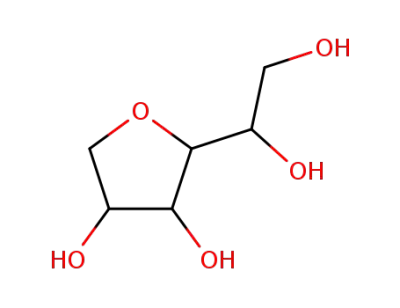
1,4-sorbitan

-
-
492-61-5
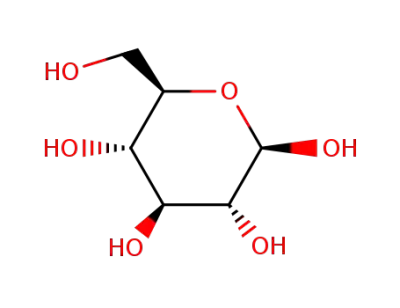
β-D-glucose
-
-
87-99-0,488-81-3,488-82-4,2152-56-9,6917-36-8,7643-75-6
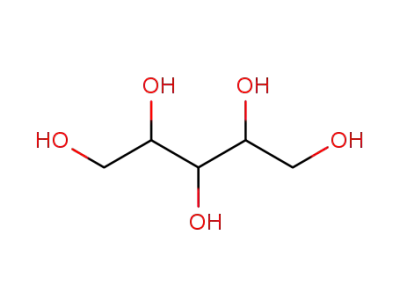
1,2,3,4,5-pentahydroxy-pentane
-
-
50-70-4,69-65-8,87-78-5,133-43-7,488-44-8,488-45-9,608-66-2,643-01-6,643-03-8,5552-13-6,6706-59-8,24557-79-7,25878-23-3,26566-34-7,45007-61-2,60660-56-2,60660-57-3,60660-58-4,132747-27-4
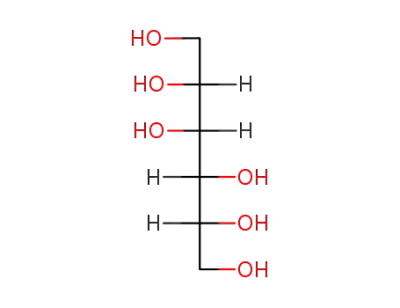
sorbitol
| Conditions | Yield |
|---|---|
|
With
sulfuric acid; 5% active carbon-supported ruthenium; water; hydrogen; tungsten;
at 159.84 ℃;
for 1h;
under 37503.8 Torr;
Autoclave;
|
-
-
58-86-6
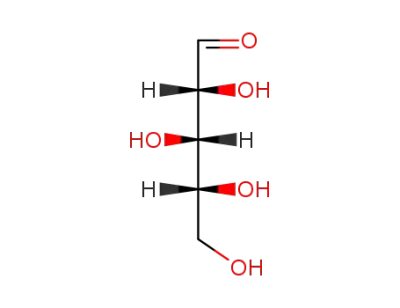
D-xylose
-
-
488-82-4
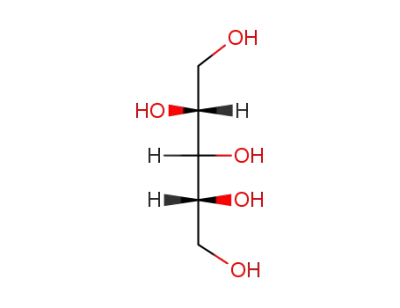
D-Arabitol
-
-
87-99-0
XYLITOL
| Conditions | Yield |
|---|---|
|
With
hydrogen; Ni6.66Fe1Al1.55;
In
water;
at 180 ℃;
for 0.5h;
under 22502.3 Torr;
Temperature;
High pressure;
|
76.97%
20.73% |
|
With
Butane-1,4-diol; Cu3Ni3Al2;
In
water;
at 149.84 ℃;
pH=9 - 10;
|
60%
10% |
|
With
hydrogen;
In
water;
at 60 ℃;
for 4h;
under 12001.2 Torr;
Time;
Catalytic behavior;
Green chemistry;
|
50%
6% |
|
With
hydrogen;
In
water;
at 120 ℃;
for 1h;
under 41254.1 Torr;
Reagent/catalyst;
Temperature;
Concentration;
Pressure;
Catalytic behavior;
Autoclave;
Inert atmosphere;
Green chemistry;
|
|
|
With
hydrogen;
In
water;
at 130 ℃;
for 2h;
under 12001.2 Torr;
Autoclave;
|
66 %Chromat.
13 %Chromat. |
488-82-4 Upstream products
-
10323-20-3
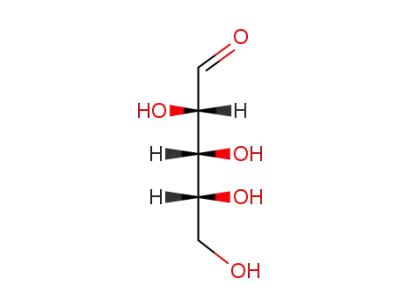
D-Arabinose
-
1114-34-7

D-lyxose
-
2280-44-6
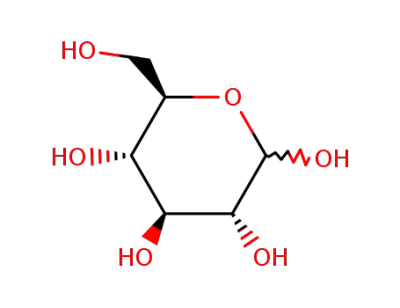
D-Glucose
-
154-17-6
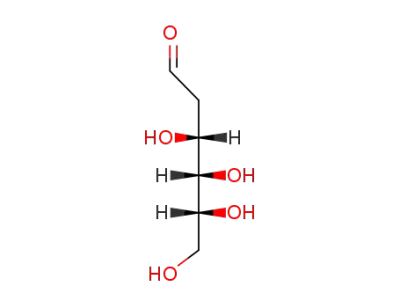
D-2-deoxyglucose
488-82-4 Downstream products
-
107-92-6

butyric acid
-
119248-59-8

pentakis-O -(2,4-dinitro-phenyl)-D-arabitol
-
5329-57-7
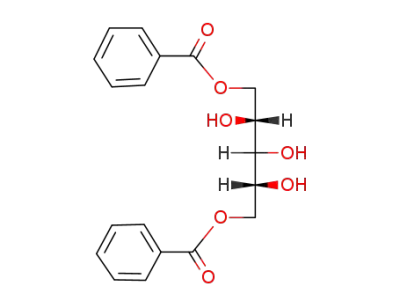
1.5-dibenzoyloxy-D-arabino -pentanetriol-(2.3.4)
-
26293-27-6

trifluoroacetylated arabinitol